Tuesday, June 7, 2016

Deep Blue and the AI


image courtesy:https://www-03.ibm.com/ibm/history/exhibits/vintage/vintage_4506VV1001.html

And its not another chess game.

Way back in 1996, a super chess power named Garry Kasparov agreed for a match with IBM’s Computer [it was still ‘computer’ without the intelligence aspect amplified] named Deep Blue. Was the name an inspiration from Deep Throat?Or is just the phonetics?

The incredible then happened. Deep Blue won the first match. History was created. Unbelievable! If it stunned the world, the chess champion shattered would be an understatement. Kasparov would recollect later about playing with computers but none like Deep Blue. 

Kasparov, as the reigning champion, was so confident about his strength that the might of the machine that made its move in the chess match was no match. It wasn’t just the champion, but the pundits and public never for once doubted. No one doubted. Just the same no one expected. Computer to dethrone the champ? It happens in the time when google was probably in incubation and software was limping its way in to our lives. The impact was limited, restricted to few and used by fewer. Times when people remembered phone numbers of their contacts and reliance on ‘hardware’ like computers was confined to space, defense and research. All things around too hardly smelled anything close to ‘software’, and programs was yet to be synonymous as software just as search with google. It was in this exciting backdrop, the fight between a human brain versus a relatively unknown machine was pitted. It might sound Ayan Randish, but there is no such thing called a ‘collective brain’ and should it exist, then it will not be mortal but machines, and rightly positioned, Deep Blue was a result of many a mind with innovations and inventions. Chess is an amazing, sophisticated and brilliant game where the mind is really placed at a premium. Its philosophical too ‘you cannot reach the white square without stepping into a black’, and game is a strategic one, just like wars fought with ‘horses and bayonets’. A great tactical move or act of blunder – whichever way, that’s the game of chess.

So imagine Kasparov moving a pawn, what should Deep Blue do in response? Defense or offence? So the machine had to think of all possible scenarios and also think further about the countermove. Its about preempting and predicting to an accuracy that’s alarming, and even freaking IQ. A normal mind cannot fathom as much, and hence Kasparov was deeply respected for his intelligence and ability to look ahead – way ahead that he could do the mental math to break all barriers or detect a breach from a distance. That was baffling. Even more would be Deep Blue, for it shocked not just the millions of multitude, but Kasparov himself was baffled by the way the system battled “But a computer, I thought, would never make such a move. A computer can't ‘see’ the long-term consequences of structural changes in the position or understand how changes in pawn formations may be good or bad.


Kasparov will go on to win the next game and eventually the championship, and we all recall  that near to impossible win of Deep Blue and cheered the challenge posed to the champion. Today the odds are reversed as we almost revere AI to the point of ubiquitous in our lives. There is no aspect in our life that AI has not penetrated. All along we lived without the knowledge of its existence. And our dependence on data is almost complete for even simple and mundane chores are reflective in our inability to store data in a machine than carry in person.

Why call it artificial? We have seen advancement exceed advancements in AI. We have seen job creation to job destruction by the very intelligence. It works both ways. Automation and robotics disrupted human lives by replacing their services and unseated their position and unsettled their lives. That’s the typical trade-off for change. Its not the cry of a luddite but all things come at a cost and technology today is the most powerful inclusion. Kasparov would state “my instincts told me “. So a celebrated chess champion still relies on his behavioral response.  Till that day, artificial will be artificial. Then again, wasn’t it a terrific wake-up call that made us stand up and salute. We owe as much to Deep Blue in enabling us to deep dive in AI.


And what the future holds…… machines might rule but will never master the creator.

The PRINCE2 Practitioner Open-Book Exam: General Tips

image courtesy: http://blogs.iadb.org/educacion/files/iStock_000005780399_Small1.jpg

The PRINCE2 Practitioner exam is an open-book format which enables those taking the exam to access Book(s) prescribed by Axelos.

PRINCE2 Practitioner Examination format
·         Objective testing
·         8 questions - 10 question items per question, each worth one mark
·         44 marks or more required to pass (out of 80 available) - 55%
·         Two-and-a-half hours (150 minutes) duration, no additional reading time
·         Open-book exam (official PRINCE2 manual only)


Open-Book -General Tips

Open-book – is in support and not as main ‘source’
It’s easy to be misled that answers are inserted in the book and all one has to do open and everything will unfold.  Progress is based on preparation. So an unprepared attempt relying on the open-book completely will expectedly make no headway as the exam is not about rote learning or remembering and recalling answers. In a scenario-based exam, the challenge lies in applying the learning in the given context for which the open-book can serve as ‘aid’ and can never replace the hard hours bunt to bridge the knowledge gap. So open-book serves more as pointers and reference and surely not the study-material during the exam.

Well-versed with core concepts and subject matter
The recommendation is to become conversant with core concepts like reading the back of your palm. How else you would able to know what lies where. In the pile of information, searching for the reference to the untrained eye is like being blindsided. The open-book will act as a guide in offering direction to look for material that can be useful while attempting on the answers. The more conversant, the easier it is to track and trace, which saves you time to spare while attempting the hard questions. Besides, you can check and confirm the probable answer by verifying the open-book, provided the answers were known prior and not by chance or second-guess.

Read, and read again the question
If you can’t get it in the first read, try again. The instinct is to eyeball or examine hastily the exam paper to run through all the questions. Understanding the question is the key in answering, and scenarios, in particular, poses the need to read the finer details for better grasp and reach. It is very much possible to miss out on some information or become confused. Enhance your comprehension.

Engage. The exam is not extempore effort
Participation without prior preparation results in poor performance. Exceptions aside, it will be ill-advised to attempt an exam without the groundwork and grooming. One has to engage with the exam planning and readiness to clear the exam in the first attempt. There are mock exams, study aids available, and sample papers similar to that of the final exam. Attempt as many to empower with the relevant knowledge and understanding so as to acquaint and anticipate. It’s never extempore.

Don’t overestimate or oversimplify
The confident mind can feel supremely strong and takes it easy and consequnetly, complacent. It is not the same as being cool before an exam. A sense of caution is expected than fear or foreboding, at the same time lethargic and laidback attitude will not take you far. Human, by nature, assume the worst and hence overestimate – which impedes progress and success. Open-book, as stated above, is again reiterated not to be interpreted as book of answers. This might make the 'smarts' ones to oversimplify  or the 'unprepared' fraught with exam fear to overestimate. Attempt on its merit.

DOs and Don’ts

DOs
  • You are allowed the access of the Axelos-approved manual. You can mark or add handwritten notes on the manual that can be referred. You can also use post-it notes for identifying sections or jumpstart to a page.
  • You have to validate the admission of the referenced book by clearly by presenting to the webcam. Open-Book should be emptied of any material concealed intentionally or inadvertently.
  • You need to open the book and flip pages in front of the camera to ascertain about hidden notes or papers.
  • You can take the exam from an authorized examination center or your training provider or online. In case, you are doing it online from a place of your choice, ensure complete compliance.


Don’ts
  • You cannot attach or affix any sheet or papers other than the allowed ‘book’.  Any inserts or attachments or pullout that violates the rules and guidelines will disqualify your candidature.
  • You cannot have hidden notes inside the book, and hence a prerequisite that the ‘Open-book’ should be subject to inspection of the web camera before the start of exam.
  • You cannot use any additional information, like sheets or papers other than the book


You can always call on us to clarify any doubts or queries about PRINCE2 exams. For contact information, please click the link http://www.icertglobal.com/contact-us or visit our website www.icertglobal.com

Monday, June 6, 2016

PRINCE2 PRACTITIONER QUESTION PAPER PATTERNS


If you have  PRINCE2 Foundation certification, then the calling is to commit to the next level and complete - The PRINCE2 Practitioner certification.

As a PRINCE2 Practitioner certified professional, you are empowered with the knowledge and understanding in applying your learning to a real-time situation or scenario, and expected to lead and manage projects in an environment that supports PRINCE2.


Prerequisites

The prerequisite to appear for the PRINCE2 Practitioner examination, as stated by the governing body Axelos, is to possess a ‘proof of passing’ from one of the following:
  • PRINCE2 Foundation
  • Project Management Professional (PMP) 
  • Certified Associate in Project Management (CAPM) 
  • IPMA Level A® (Certified Projects Director) 
  • IPMA Level B® (Certified Senior Project Manager) 
  • IPMA Level C® (Certified Project Manager) 
  • IPMA Level D® (Certified Project Management Associate) 


Exam Format

The exam format is as follows:
  • Objective testing
  • 8 questions - 10 question items per question, each worth one mark
  • 44 marks or more required to pass (out of 80 available) - 55%
  • Two-and-a-half hours (150 minutes) duration, no additional reading time
  • Open book exam (official PRINCE2 manual only).


 PRINCE2 PRACTITIONER QUESTION PAPER PATTERNS

Please note that this exam is available for participants registered Accredited Training Organization.

Sample Paper
Having completed the certification course, it is strongly recommended that you try the ‘free Sample PRINCE2 Practitioner Exam’, offered by Axelos. This will present an overview and help you become familiar with the exam pattern, type of questions, severity of questions and so on. It arms with you awareness and helps you to prepare with a sense of anticipation. You have the option to take the test soon after completing the course to assess you own level of understanding and knowledge transfer or you can prepare prior to the test to get a first-hand evaluation of your own competence in cracking the exam.

Objective Test
The objective test will vary slightly from the usual objective answers, wherein, one correct answer needs to be selected. PRINCE2 Foundation follows this pattern of answering. However, in PRINCE2 Practitioner, there might be questions that may have more than 1 correct answer, and hence be informed about this departure from the tradition ‘objective answers’.

Knowledge Areas
There will be eighty questions in all and each carry 1 mark. You have to score a minimum 44 to clear the certification exam, which is 55%.  The question will be posed from knowledge areas and hence it’s imperative that you cover all topics and become conversant with the syllabus areas.
The PRINCE2 Syllabus contains 15 defined syllabus areas covering each of the seven themes, each of the seven processes and an overview area also covering the principles and tailoring PRINCE2 to a project environment.
Within the Practitioner Examination, there will be 6 “theme” questions, each testing one of the 7 themes, and 2 “process group” questions, which will test 2 of the 3 groups of processes as identified below.
Each of the eight questions will test a minimum of 2 syllabus topics from within the syllabus area.
Syllabus Area
  • Business Case theme
  • Organization theme
  • Quality theme
  • Plans theme
  • Risk theme
  • Change theme
  • Progress theme
  • Starting up a Project and Initiating a Project Processes
  • Directing a Project, Managing a Stage Boundary and Closing a Project Processes
  • Controlling a Stage and Managing Product Delivery Processes


Open Book
Within each question the syllabus area to which the question refers is clearly stated.
The exam is to be taken with the support of the PRINCE2 Manual only. Remember, you cannot use any other book or resource, that is i.e. no material other than the Question Booklet, the Scenario Booklet, the Answer Booklet and the PRINCE2 Manual is to be used and ‘Open Book’ conditions as have to be complied. We will discuss about open book more in detail as a blog post.
Types of Questions
You can expect the 80 question posed in the certification exam. And they are presented in 5 different formats as detailed below.
Classic Multiple Choice Questions: the typical objective-type question wherein you need to select a right answer from the given choices
Multiple Response: you have to select 2 options from the list of 5 options. This marks the exception in the pattern by prompting for more than 1 answer.
Matching: the options on the left column need to be mapped to the correct answer in the right. Please note that there is only one match and there are possibilities of multiple matches. Meaning for 5 options on the left column, it is entirely possible that option 1, 2 and 3 can have the same mapping on the right column.
Sequencing: ‘position events in a sequence’. You need to answer the options like stacking in a sequence.
Assertion/Reason:  You need to evaluate two statements a (an assertion and a reason) and confirm if they either, or both or neither with the help of reasons detailed in the question.

Capturing the Answer
In the answer leaflet, make sure the oval shapes are completely filled with PENCIL only. You have 150 minutes to answer questions. Hence your time management and answering ways should be 100% fill. Its an electronic submission and correction and hence filling the oval shapes that you find as the correct answer should be neatly and completely is the compelling factor. Failure in doing so may result in the making the answer null and void as system will be unable to ‘read’.

Friday, June 3, 2016

Areas of Improvement for the ITSM (IT Service Management) Sector

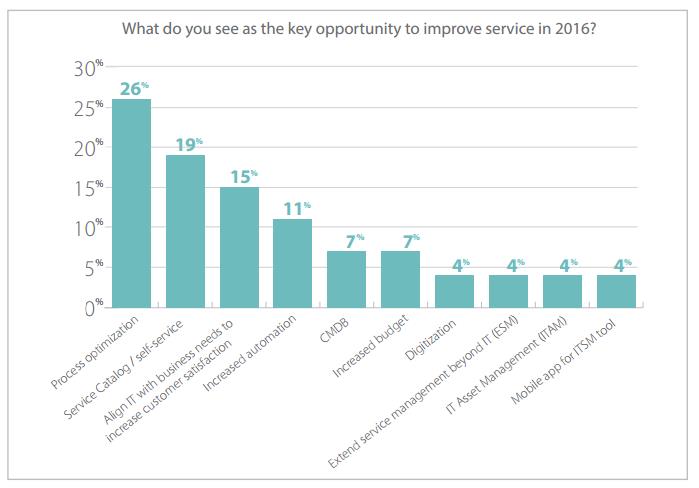
The Internet growth has reshaped service and its outlook. The ITSM best practices and processes put in place so that organization can step-up potential, performance and profit. The service aspect, unlike the software, is not the cynosure yet the product lifecycle will be incomplete, if not, stunted without service in its place. More often, repeat orders [read as customers] are the key business drivers, and in order to gain confidence and increase traction, improve service. In the ITSM realm, the stress of service is on information and technology (IT) – as the definition states design, delivery, manage and improve IT services within an organization to meet its business goals.

source: http://forms.axiossystems.com/top-10-itsm-goals-2016


Process optimization:
The most pressing issue as highlighted by a number of service management experts is Process Optimization. How can you maximize efficiency at minimum cost? Process Optimization.  The key is to identify the areas which have the best impossible impact to effect. A typical scenario to understand optimization is automation. Setting auto-response to any query, instead of acknowledging receipt manually is the basic automation that goes unnoticed but very effective. Process optimization will ensure compliance adherence, increased accountability and avoid wastage.

Self-service:
Self-service is a hard-biting issue that still finds itself lagging and lacking for want of a better system. ITSM should be optimized to offer the experience of self-satisfaction. While customer-satisfaction is paramount, the interest of the self shouldn’t be delayed or discarded.  The Self-service issue was a priority in the previous year 2015 which went unaddressed as expected and given the lacuna, the need to close the gap and plug holes took precedence over other priorities for 2016. Any issue important can be read as a good opportunity to make the most and hence focus is on improving the service standards.

IT – business alignment:
The synergy between IT and Business always results in a greater yield. to understand IT-Business alignment, you need to understand how and where does IT and Business connect. How are your meeting with customer captured? And how does technology enable business? You might want to look at dashboards that typically summarize the events and present critical information to empower informed decision-making. Its very much a strategic call, like  IT Governance with risk and compliance management.


The insights posited as trends or ‘Opportunities’ for 2016 is more of reflection from the remnant and projections for future. While Process Optimization was closely followed by self-service, the value of aligning business needs to increased customer satisfaction too was a pronounced call for action. Strong indication was sounded for Automation mainly to streamline process and resources and avoid waste of time and material. The list also featured Budgets, Digitization ESM and ITAM. While Budget and Digitization are prospects, ESM and ITAM stem from the remnants of 2015.


The Status of 2015.


The trends of 2015 was studied to understand the reach and addressal; and the understanding is that Services found wanting and fell short on Self-service, Service beyond management and IT Asset Management. The table below depicts the findings.

source: http://forms.axiossystems.com/top-10-itsm-goals-2016


Self Service:
When user is self-empowered, the dependence on others can be cut down to improve productivity. Usually time-chokers, when issues have to be resolved by ‘someone’ always burdens the user with increased reliance on resources. Instances when access to a particular site is blocked that not only interrupts your work but arrests the thought flow, scuttling spontaneity  and slowing work as a result, all in the aspect of security? There is always a better way to get things done without compromising security and still serving the self-service. The ITSM can step-in to sort out the mess and streamline flow to avoid interruption and enhance engagement.  The service desk inexplicably, fails to empower self-service

Service management beyond IT:
It is also known as Enterprise Service Management (ESM), which can optimize service management to pass on benefits to other departments like Human Resources, Finance, to improve delivery.  If you have to follow-up on a leave request or a loan applied, will it not be necessary to touch base with HR for eligibility and approval, and pass the request to Finance to disbursement? The services that can make the entire process seamless, cutting out the delay and accelerating the request-response will result in greater satisfaction.

IT Asset Management (ITAM):
Software management is significant because of its need and value, and also the adherence, compliance and audit check makes it increasingly important to manage your assets. Its observed from industry practice and use that aligning asset management with service management will result in substantial cost reduction. You will be able to better control and become cost-effective through screening and shortlisting to prioritize and take preventive measures to ac\void any attack or breaches in safeguarding your assets and value.

Some of the critical shortcoming in 2015 were lined up for redressal and remedy in 2016 and   prominently featured were self-service and IT Asset Management.

You may please access the white paper which requires registration.


For more information about our ITSM programs, we request you to visit our website  http://www.icertglobal.com/all-courses or call the nearest branch close to your locality.

Wednesday, June 1, 2016

It’s the way you type, not what you type – the amazing development with Artificial Intelligence

image courtesy: http://static4.techinsider.io/image/560434a99dd7cc18008bcd37-2513-1885/ex-machina-movie-artificial-intelligence-robot.jpg

Password could be a pain, particularly when you have multiple web sites to access many sites. The consumer complains that passwords are fast becoming a psychological burden – an albatross that weighs down the person with too much data dumped in the head that’s hard to decipher. And apparently one can sense discomfort and disconnect.  It’s like having too many keys to open one room and woefully, you can’t pick out the right one which will unlock. And the real hassle is when password is forgotten and the allowed number of ‘attempts’ gets exhausted, the system locks, leaving you stranded but the chore running back and forth with the back-office executive walking-through the password retrieval process leaves you fuming ‘is technology a boon or bane’. Anything will have its downside – including technology.  You might want to have a turnkey system that does the trick and get you going.

Password, PIN  and  Breach
Recent times have witnessed worst security breaches because of weak passwords. How private information lands in the public domain makes it a necessity to ensure that safety mechanism are in place and hence stronger password. But too many passwords? Why? Google has single sign-on to access all its application. Why can’t life be simpler? Or are we complicating in the name of security? The easy way out would be to have one password for all sites so that you really don’t squeeze hard your memory like sifting sand from grains. If it makes your life easier, then think about the breach and there it goes – with one key all of yours is ‘gone for good’. It was this paradox that actually turned out to be the problem statement. Single-point of entry is swift but so would be the theft. In this era of technology, and digitalization, all access points are fortified through authentication. Multi-tier security system or secured transaction or secured authentication service. Still, we are not done with the password for an alternate method that’s more convenient and confident. Almost everyone with digital experience would have yearned for that day they could dispense with password or PIN (Personal Identification Number) which earlier was recommended to be bolstered from breach by creating an alpha-numeric string with a heady mix of special characters to safeguard from sabotage, and now some institutions like Banks make the usage of special characters mandatory visualizing that invincible predator preying on vulnerable victims, and soon emerged phishing as one the worst attack on data integrity. With reputation in ruins, name in tatters and business rocked in its very foundation, damage control and image building exercises not only resulted in spiraling costs with a dent on the bottom-line, but kept the stakeholders on tenterhooks. So it would, by no stretch of imagination, become too much to bear for all the stakeholders and so far the necessity of the hour and lack of alternative left the end-user with no choice but coin the Password or PIN as complex as possible and remember it for good and retrieve on-demand. Further, it was strongly discouraged in storing the information in hard or soft copies, and science dealing with encryption and decryption made it even more mystique and technology related to secured socket layer took over. 

Abacus – the painkiller?

It is possible to solve every puzzle? At least, for the password related problem Google believes it can achieve a breakthrough by getting rid of the stiff impositions of barriers – NO PASSWORD.

How in the world would you access your information whether it’s an email or your bank account? Google assures that there is a ‘fix’ and will test with bank first and based on its success, offer for others.
Dan Kaufman, Head of advanced technology and projects at Google, commented at the company’s I/O developer conference “We have a phone, and these phones have all these sensors in them. Why couldn't it just know who I was, so I don't need a password? I should just be able to work,"
How does it work?
The technology uses biometric data and supporting information to identify and authenticate access. It uses Trust API to determine ‘trust score’ by employing and engaging different parameters like facial recognition, location, typing styles to ascertain the identity of the user. To access sensitive information, the ‘trust score’ should be high, and that’s the reason the testing begins with a financial institution. The higher the score, clearer is the  identification and access  provided, else, denied. Interestingly, Kaufman, has this to say about authentication "What we're going to do with this is be able to get rid of the awkwardness of second-factor authentication,"
Google assured to introduce this ‘password-free’ feature to every android developer by this year-end.
Is there a Precedent for ‘No-Password’?
The answer is in the affirmative. Yes.  Let’s not take away the shine off Abacus and assess on its own merit. Scandinavians will be familiar with this concept of logging into their bank accounts using behavioral biometrics and not a password. The password is queried only when the usual signs and symptoms fail to be detected and is treated as a legitimate case in validating the customer identification . In Norway and Sweden, major banks employ BankID for doing daily banking transaction to booking tickets or applying loan or paying taxes online.  It was estimated that by 2014,  BankID is used by over 3 million Norwegians (over 75% of the adult population(pdf).

BankID can identify the user through a combination of factors like assessing the way the screen is swiped, the pace at which data is keyed – meaning the pressure with which you punch-in data is critical to analyze and evaluate your identity. It is behavioral science at an advanced level that any change in pattern or shift in style will trigger the system to confirm with a ‘password’ prompt. The system has studies the user to identify as its customer. This is made possible by behavioral biometrics layer of BankID.

So Behavioral Biometrics is nothing new; the anticipation is the evolution of technology in this space of biometrics in the context of identity crisis. We may to have wait till the year-end to see what the future unfolds.

Tuesday, May 31, 2016

Can Artificial Intelligence ‘alert’ Project Managers?


image courtesy: https://static-secure.guim.co.uk/sys-images/Guardian/Pix/pictures/2015/2/9/1423493115325/36d9f284-bf72-4e1f-82d0-ef0194ccfa43-2060x1236.jpeg


This blog is written in the backdrop of Google’s CEO Sundar Pichai heralding “Artificial Intelligence’ as “We will move from mobile first to an AI first world." in the recently held Google I/O 2016.  Science becomes spectacular in its endeavor to make possible the deemed impossible, reminding Robert Kennedy “There are those that look at things the way they are, and ask why? I dream of things that never were, and ask why not?”

Sometimes it’s so surreal. When the movie ‘Minority Report’ , a concept conceived in the late nineties and hit the silver screen by 2002, the reviews about the sci-fi was superb and many wondered what could the world be in 2054  as set as timeline in the movie. It was half-a century away. Everything can be put in place past the event or outcome but possible to predict something to happen with precision? Plausible? From a technology perspective, the spectacle that dazzled us with 3-D, touch screen depicting data on-demand, transportation and logistics, the movie ported us to a scientific space of sophisticated software and advanced intelligence.


Artificial Intelligence as the key driver

The breakthrough in AI is simply breathtaking. and going places that Mars may not be the final frontier. Today you can key-in or just use voice for search – any kind of search. Different people have different needs and the system is so intelligent and efficient to identify the ‘searcher’ to serve customized results and also recommendation on the screen.  IBM is working on digital advertising screens that can play advertisements best suiting the consumer’ preference using the RFID technology, picking their shopping flair and taste from their payment cards and phones that use RFID chips.  

A Japanese company has created digital signage that can organize through The customer facial recognition software and cameras helps to identify the gender, age and range in displaying advertisement best fitting the democracy - Typical customer-centric campaigns to promote products and services.

If anything, AI is growing from strength to strength. Look no further for evidence – just search for something in Google and check how soon and swift the results came through.  Does it rain or shine? The forecast for the week?  Or check the kids play Mariocart or Xbox where simulations or gesture-based gaming to the  driverless car. In the movie Minority Report, the newspaper will update itself for latest news. Today, why don't you   check the Google news page which is almost there with its updates, though not auto-refresh.  There is much more than that meets the eye. This is an era of information overload and hence developments sometimes are overshadowed or even go unnoticed.  Impressively, human’s pursuit to make ideas to realities is relentless.


Artificial Intelligence and Project Management

What’s the probability that the lead programmer in the team will show up for work tomorrow? Will the server hold up till the end or tank all of a sudden? Will the project meet its deadline and deliver?

Your guess is as good as anyone.  

For the scope of this account, let’s confine to human resources and hardware. If Big Data is growing powerful with predictive analysis as a powerful and potent tool, what will happen Artificial Intelligence is employed to study and predict personnel about presence and performance.  Can the Intelligence available alert about the impending change(s)? Can we leverage on behavorial biometrics for human identficiation and expand its scope to mine data?

In Seoul, AlphaGo, an AI system created by Google, crushed Lee Sedol, an 18-time world champion who is regarded as the decade's top player of Go - an abstract strategy board game. The victory meant that "AI-calculated-faster-than-a-human”. Agreed, but the AI-calculator was again created by human mind and its very unfair to state Seedol lost, rather collective brains won that day.

So if Big Data can do the imagined and beyond, can it rise up to the challenge is by providing statistics and information about human behavior, more from human physiology and psyche? Efforts are underway and research is ongoing, like ‘social character’ , or ‘Human Genome Project ‘providing insights into genes, which hopefully can wade into rough waters to understand the incredibly complex human system. Though the goal of this study of Human Genome is to create personalized medicines, use analytics to check a cure is within a particular timeline, can it not encompass behavioral traits as well? 

The if-only theory that a Project Manager applies in analyzing team’s composition and hardware infrastructure – “if only the server didn’t shutdown without warning”, “if only the programmer didn’t fall sick”, “if only the architect didn’t drop his papers ”, “if only there was a backup before the power failed”…….all these can be written as useful Use Cases with alternate scenarios. From a Project Manager’s desk, Technology in the form of Big Data and Artificial Intelligence can empower at arriving at informed decisions – especially about health reports of both men and machines, then risks can be mitigated to a greater extent and the assurance of the success of any undertaking will be expectedly high. Artificial Intelligence, in this context of human understanding and analysis,  is extremely challenging given the multi-layered, multi-dimensional and multi-faceted undertaking that’s complicated in its complexities. Many doubt its possibility, but then so did the skeptics when “Minority Report’ was released.  Spielberg views sounds psychic “I wanted all the toys to come true someday. I want there to be a transportation system that doesn't emit toxins into the atmosphere. And the newspaper that updates itself...

Mankind shares the same sanguinity that Artificial Intelligence arms the Project Manager with the ability to view way ahead in predicting scientifically about a project holistically - the entire ecosystem.

Friday, May 27, 2016

Are you Reading the Risks Right or is it Target Missed? – a Case Study | Project Management

Profile
A high-tech company in the travel industry has bagged a contract from a reputed Client for data migration with phased delivery over a period of ten quarters.  

The project plan was created based on the requirements available. Since the project spanned in time, the data points presented covered only a year, which was deemed good to start by stakeholders.  The visibility was for only one year and hence the limitation with data available – which is expected and accepted in this kind of engagement. The budget for the said timeline was apportioned. The team identified to undertake the project was present in different locations as a strategic call.

The Pain Point
It will be the assumptions that will turn out to be the worst of risks. The stakeholders agreed it was a long tunnel but not quite certain about the length.  Since it was a time bound, the requirement gathering was focused for the first quarter as agreed by the stakeholders and signed-off.

Assumptions can become one of the major risks. The team initially settled on a framework only to change after the first sprint. The change would impact the team composition calling for ‘sourcing’ soon after launch that sent the human resources scrambling for talent. The need of the hour is never met and that’s the lesson learnt and hence due diligence paid to the selection from talent pool.

With new resources inducted, there was already burn on time and cost, the knowledge transfer turned out to be to be too steep and the project plan revisited to factor the changes. There were different verticals within the team which started concurrently, and it was the approach of the scheduled milestone that sent the alarm bells ringing as one of the core development team failed in meeting the deadline and thereby derailed further developments adversely impacting other teams as the output will be the primary feed for them to move forward. It had a typical domino effect shaking the entire team.

When the causal analysis was conducted, the results unearthed many issues that seemed to be swept under the carpet. Communication weren’t open and transparent; accountability absent and leadership clueless as team members tried passing the buck and concerned about safeguarding their position. The most baffling will be the lack of attention to basic details. There should have been a single point of contact for escalation; People Management and Stakeholder management. The root cause clearly spells poor communication and lack in understanding.  The bottleneck undoubtedly was communication management. Clearly the opportunity would have been squandered if not for the milestone. It was the worst wake-up call for a company known for its intellectual capital and track record.

Analysis revealed that the actual against planned in the project plan left a gaping hole and lacked foresight for risk mitigation particularly  to problem faced   as such a scenario was never contemplated.  How? That’s why the absence to attention on basic details. Too much rode on assumptions.

The impacts due to the imbalance resulted in
# changes in the team composition which proved too expensive at that point in time as investment and Knowledge Transition and team ramp-up
# Conflicts in the mid-management

The squabbles stressed the need for conflict resolution through effective people management and stakeholder management.

Troubleshooting
It was back to basics about team-building with open communication, more transparency and greater accountability.  The team met frequently till all onboard were on the same page. Having ceded grounds, it’s more prudent to save and salvage and move on. Since it was the first milestone, the impact on the short-term goal was severe and long-term could be contained. The positive impact can be captured as
# Commitment from the stakeholders on requirements and delivery
# Transparency /Clarity  to all the stakeholders


Recommendations

  • The Plan B that somehow missed the plan should be prepared.
  • The alternate scenario for worst cases should be assessed and addressed.
  • The assumptions must be studied again and stakeholders should provide clarity in closure.
  • The team should be cohesive and engage effectively to expedite delivery.
  • The Start of the Day and End of Day of meeting must analyze the day’s target and plan for next day deliverables.
  • The leadership to introduce SPOC and take stock at regular intervals (smaller intervals as possible) till things are streamlined and then schedule the standard stand-up meetings